Corporate Social Responsibility has become an important part of how businesses create social value.
But there is a less visible challenge behind every CSR programme:
How do you keep track of what happens after the funding is committed?
For CSR teams managing multiple NGO partnerships, information can quickly become fragmented.
One NGO sends an Excel sheet.
Another sends a PDF.
Another shares updates over email.
Certificates sit in different folders.
Fund utilisation information arrives at different times.
And when management asks for a consolidated view, someone starts compiling everything manually.
The problem isn't a lack of data.
It's a lack of connected data.
More information doesn't automatically mean more visibility
Imagine a CSR manager supporting 10 NGOs.
Each NGO has:
• Different campaigns • Different reporting formats • Different timelines • Different documents • Different points of contact
Now imagine trying to answer a simple question:
"Where are all our CSR-funded projects right now?"
If the answer requires opening multiple spreadsheets, emails and PDFs, the organisation doesn't have visibility.
It has documentation.
There is a difference.
What CSR teams really need
A modern CSR compliance system should make it easier to answer questions such as:
Which NGOs are we funding?
Are their certificates current?
How much has been contributed?
Where are the funds being utilised?
What impact updates have been published?
What information can we present to leadership or the board?
The objective isn't to generate more reports.
It is to make the right information available when it is needed.
Technology can create one source of truth
This is where platforms such as Impact Saathi can play an important role.
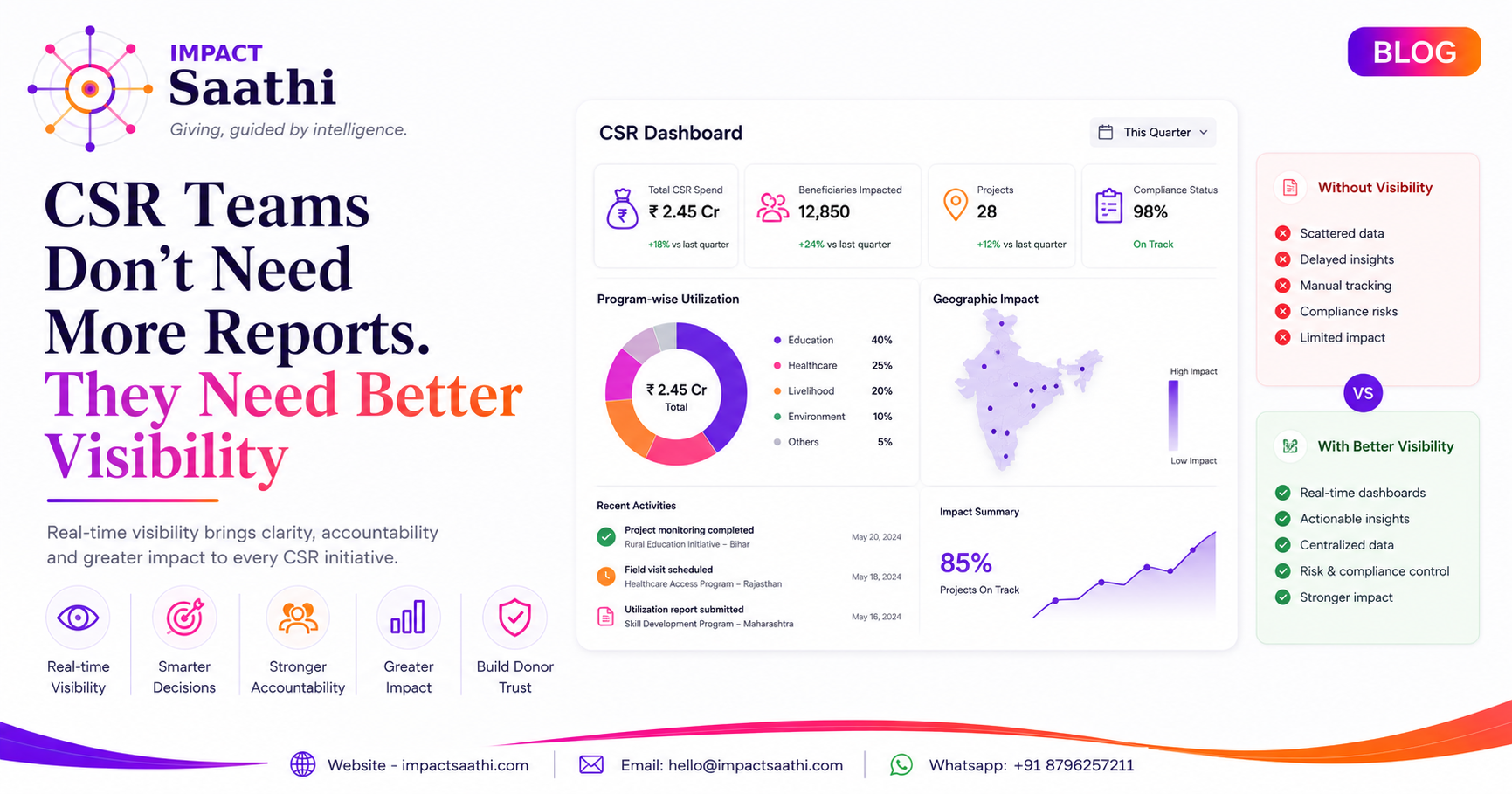
Impact Saathi's Corporate Enterprise approach provides CSR teams with a consolidated compliance and reporting view across linked NGOs.
Instead of treating each NGO relationship as an isolated data source, the system connects the information.
Certificate status.
Fund utilisation.
Donation records.
Reports.
Documentation.
The result is a clearer picture of the CSR portfolio.
The next evolution of CSR technology
The first generation of digital CSR tools focused heavily on discovering opportunities and managing programmes.
The next opportunity is different.
It's about accountability after the funding happens.
Because CSR doesn't end when the cheque is issued.
It continues through implementation, utilisation, reporting and impact measurement.
The better these processes are connected, the easier it becomes for organisations to demonstrate responsible use of funds.
Trust is becoming measurable
Stakeholders increasingly expect organisations to demonstrate not only that they spent money, but also that they managed it responsibly.
That means compliance and transparency cannot remain back-office activities.
They need to become part of the technology infrastructure supporting CSR.
At Impact Saathi, our vision is simple:
Give NGOs and CSR teams a shared, reliable layer for donation compliance, fund utilisation and reporting.
Because when everyone sees the same underlying record, accountability becomes easier.
And when accountability becomes easier, social impact becomes easier to trust.
CSR needs fewer disconnected spreadsheets and more connected systems.
#ImpactSaathi #CSR #CorporateSocialResponsibility #SocialImpact #NGO #CSRIndia #Compliance #Transparency #DigitalTransformation