
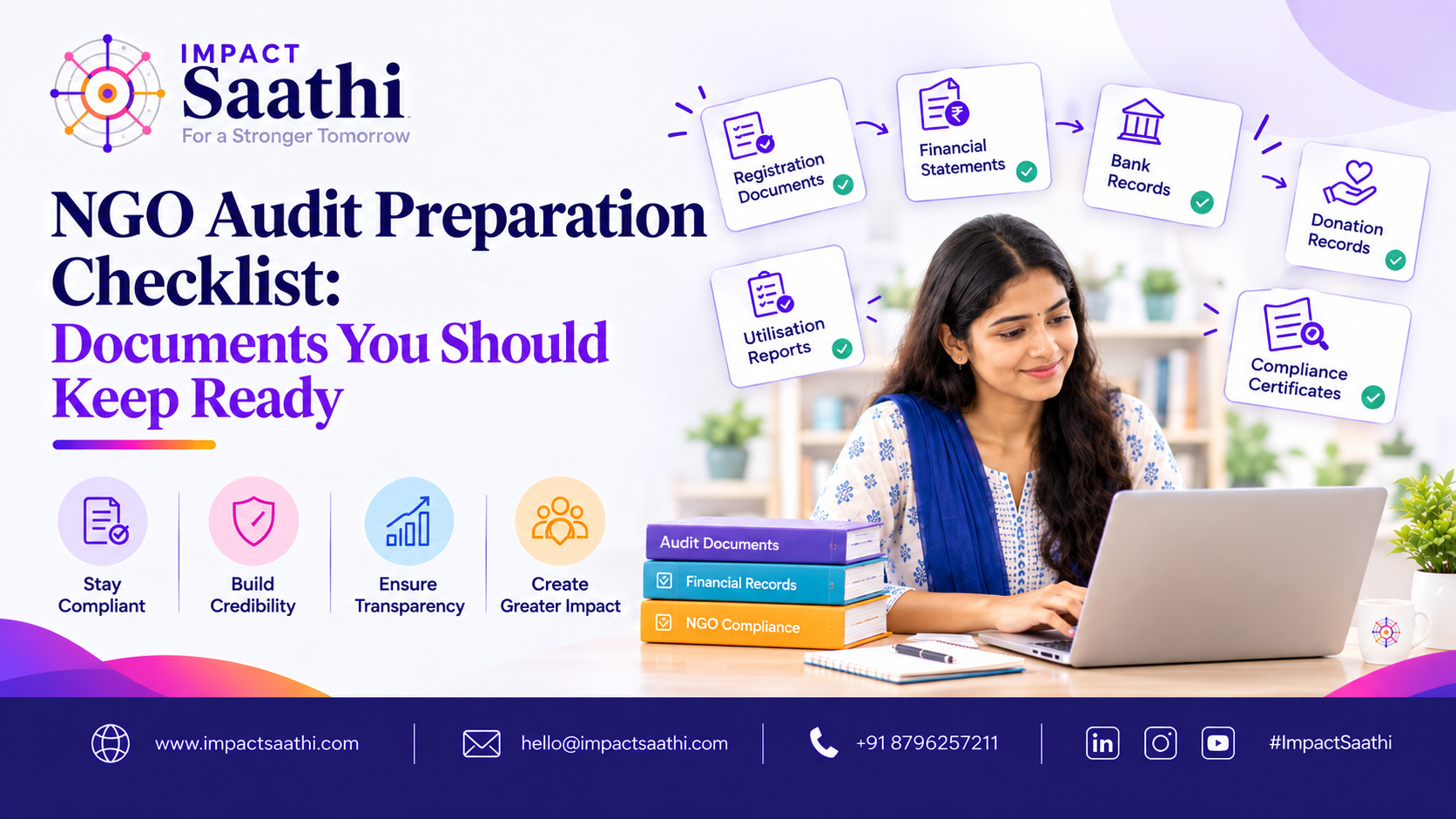
For many NGOs, the word "audit" immediately creates pressure.
Teams begin searching for invoices, bank statements, donation records, certificates, payment proofs and project documents. Files are downloaded from emails. Spreadsheets are reconciled. Old documents are requested from former employees.
This situation is often preventable.
Good audit preparation is not about collecting everything at the last minute. It is about maintaining an organised record system throughout the year.
An NGO that keeps its financial, compliance and operational documents properly organised can approach audit preparation in a much more structured way.
This guide provides a practical NGO audit preparation checklist that organisations can adapt to their own requirements.
The exact documents required will depend on the NGO's legal structure, applicable laws, funding arrangements and auditor's requirements. NGOs should always confirm specific requirements with their auditor or qualified professional.
What Is an NGO Audit?
An audit is an independent examination of relevant financial records and other information to provide assurance according to the applicable framework.
For an NGO, the audit process may involve reviewing:
Financial statements
Accounting records
Bank transactions
Income
Donations
Grants
Expenses
Supporting documents
Assets
Liabilities
Statutory records
Project-related information
The purpose is not simply to check whether numbers add up.
A well-maintained audit trail helps demonstrate how the organisation received, managed and used funds.
Why Audit Preparation Should Start Early
Many audit problems are caused by missing documentation rather than complicated accounting.
For example:
A payment appears in the bank statement but the invoice cannot be located.
A donation appears in the accounting system but the corresponding receipt record is missing.
A project expense exists but the supporting approval cannot be found.
A certificate is valid but its latest copy is stored on an employee's laptop.
The solution is a consistent documentation process.
NGO Audit Preparation Checklist
1. Organisation Documents
Maintain updated copies of:
Registration documents
Governing documents
PAN-related documents
Applicable tax registration documents
12A-related documentation
80G-related documentation
FCRA documentation, where applicable
CSR-related registration, where applicable
Board or governing body records
Important organisational policies
Keep these documents in a central and access-controlled repository.
2. Bank Records
Bank records are among the most important audit documents.
Maintain:
Bank statements
Bank reconciliation statements
Cancelled cheque records where relevant
Bank confirmations where applicable
Details of bank accounts
Supporting documentation for significant transactions
Bank reconciliations should ideally be performed regularly rather than only at year-end.
3. Donation Records
Donation records should be traceable from receipt to accounting record and bank transaction where applicable.
Maintain:
Donor details
Donation date
Amount
Payment method
Receipt number
Receipt copy
Relevant supporting information
Campaign or project association where applicable
Digital donation systems can reduce manual duplication by connecting payment information with receipt records.
Impact Saathi describes an end-to-end donation flow in which confirmed payments are recorded, 80G receipts are generated and the receipt is stored as part of the audit trail.
4. Expense Documentation
Every material expense should have appropriate supporting documentation.
Depending on the transaction, this may include:
Invoice
Bill
Payment proof
Approval
Purchase order
Agreement
Expense claim
Vendor details
The exact documentation requirements depend on the nature of the expense and applicable policies.
A useful internal rule is:
No significant expense should exist without an identifiable reason, approver and supporting evidence.
5. Payroll and Employee Records
Where applicable, keep:
Salary records
Payroll summaries
Employment documentation
Attendance records
Reimbursement records
Applicable statutory records
Payment proofs
Access to employee information should be restricted because payroll records contain personal information.
6. Grant and CSR Records
NGOs receiving grants or CSR funding should maintain documentation related to each project.
This can include:
Funding agreement
Project proposal
Approved budget
Project timeline
Disbursement records
Utilisation information
Progress reports
Photos or supporting evidence
Outcome information
Communication with the funder
The records should make it possible to connect funding with project activities.
7. Fund Utilisation Records
One of the most important questions for any funded project is:
How were the funds used?
An NGO should maintain records that help explain:
Amount received
Date received
Project allocation
Amount spent
Category of expenditure
Remaining balance
Supporting documents
Clear fund utilisation records can also improve donor communication.
Impact Saathi's platform specifically includes fund-utilisation updates intended to provide donors with information about how contributions are used.
8. Fixed Asset Records
Where applicable, NGOs should maintain a fixed asset register.
It may include:
Asset description
Purchase date
Purchase value
Location
Identification number
Responsible department
Disposal information
Physical verification can help identify missing, damaged or incorrectly recorded assets.
9. Contracts and Agreements
Maintain copies of important agreements with:
Donors
CSR partners
Grant providers
Vendors
Consultants
Employees
Service providers
A central repository makes it easier to retrieve documents during an audit.
10. Board and Governance Records
Depending on organisational structure, maintain relevant:
Meeting notices
Agendas
Minutes
Resolutions
Approvals
Policy approvals
These records can provide evidence that important decisions were appropriately authorised.
11. Project Documentation
Financial information should be connected to programme information.
For every major project, maintain:
Project description
Objectives
Budget
Activities
Beneficiary information where appropriate
Progress
Expenses
Outputs
Outcomes
Reports
This helps demonstrate the connection between money spent and programme activity.
12. Create an Audit Request Folder
Once the auditor provides a document request list, create a dedicated folder.
For example:
Audit 2025–26
→ 01 Organisation
→ 02 Bank
→ 03 Donations
→ 04 Expenses
→ 05 Payroll
→ 06 Grants
→ 07 CSR
→ 08 Assets
→ 09 Compliance
→ 10 Financial Statements
This structure allows staff to respond to requests systematically.
13. Use a Document Naming Convention
A simple naming convention can save hours.
Instead of:
scan123.pdf
use:
Invoice_ABC_Suppliers_12500_15-06-2026.pdf
The exact naming format can vary.
The important elements are:
Document type
Organisation/vendor
Amount where useful
Date
Reference number
14. Maintain a Document Index
A document index can contain:
Document
Location
Owner
Status
Bank Statement
Digital
Finance
Available
Donation Register
CRM
Fundraising
Available
Grant Agreement
Drive
Programme
Available
80G Document
Compliance
Admin
Available
This makes missing information easier to identify.
15. Review Before the Auditor Arrives
Conduct an internal pre-audit review.
Ask:
Are all bank accounts reconciled?
Are major expenses supported?
Are donation records complete?
Are certificates current?
Are grant documents available?
Are project expenses traceable?
Are important approvals documented?
Are financial statements consistent with underlying records?
The objective is to identify gaps before they become audit queries.
Common Audit Preparation Mistakes
Keeping everything in one person's email
This creates a single point of failure.
Storing documents without structure
Having 20,000 files is not useful if nobody can find the required one.
Mixing financial and personal documents
Sensitive information should have appropriate access controls.
Not retaining approvals
A transaction may be financially valid but still require evidence of internal approval according to the organisation's policy.
Preparing only at year-end
Audit readiness should be maintained throughout the year.
How Technology Can Improve Audit Readiness
A digital NGO management system can help create:
Searchable records
Document repositories
Audit trails
User permissions
Automated reminders
Donation histories
Compliance alerts
Financial reporting
The objective is not to eliminate the auditor's work.
It is to ensure the organisation can provide reliable information efficiently.
Conclusion
Audit preparation becomes significantly easier when documentation is treated as an everyday responsibility.
NGOs should maintain organised financial records, donation documentation, grant records, project information, certificates, agreements and governance documents throughout the year.
A strong audit preparation system has three characteristics:
Complete records.
Clear ownership.
Easy retrieval.
When these three elements are in place, audit preparation becomes a routine process rather than a year-end crisis.
FAQs
What documents should an NGO prepare for an audit?
Common categories include financial records, bank statements, donation records, expense documents, registration documents, grant agreements, project records and governance documentation. Exact requirements depend on the organisation and applicable framework.
How early should an NGO start preparing for an audit?
Ideally, audit readiness should be maintained throughout the year. A formal pre-audit review can begin several weeks before the audit.
Should NGO documents be stored digitally?
Digital storage can make documents easier to search, organise and retrieve. Appropriate security, access controls and backups are important.
How long should NGO records be kept?
Record-retention requirements can vary by document type and applicable law. NGOs should establish a retention policy with professional advice where necessary.
What is an audit trail?
An audit trail is a record showing the history and supporting evidence behind a transaction, decision or activity.
Can an NGO use cloud storage for audit documents?
Yes, provided the system has appropriate security, access controls, backups and organisational policies.
What is the most common audit preparation problem?
Missing or poorly organised supporting documentation is a common operational problem. Maintaining records throughout the year reduces this risk.