For many NPOs, spreadsheets are not just a tool.
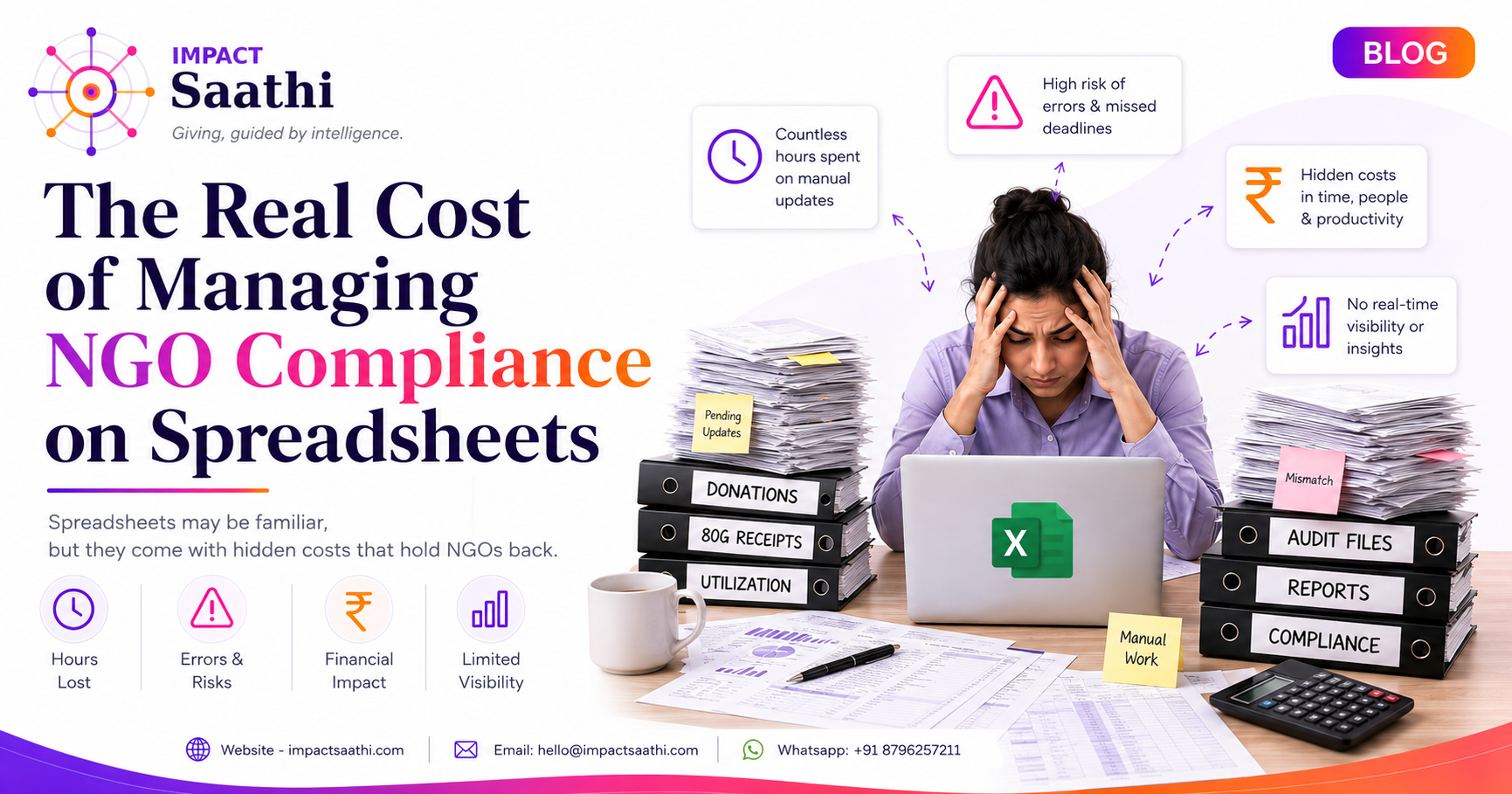
They are the backbone of donation tracking, 80G receipts, certificate records, donor communication and fund-utilisation reporting.
And for a long time, that worked.
But as an NGO grows, the spreadsheet starts becoming a risk rather than a solution.
A donation comes in.
Someone updates an Excel file.
Someone else prepares the 80G receipt.
Another person sends it to the donor.
Fund utilisation is tracked somewhere else.
Certificates are stored in folders.
Donor communication happens through email or WhatsApp.
And when an audit arrives, the team starts searching.
The problem isn't that NPOs don't care about compliance.
The problem is that the process is fragmented.
One missed field can create a bigger problem
An 80G receipt isn't simply a thank-you note.
It carries important information that needs to be accurate and properly recorded.
When receipts are prepared manually, there is always a possibility of:
• Incorrect donor information • Missing fields • Duplicate receipt numbers • Delayed communication • Lost records • Difficulty retrieving historical information
The larger the NGO becomes, the harder it is to manage these processes manually.
Compliance should not depend on one person's memory
Imagine an NGO administrator who knows exactly where every certificate, receipt and donor record is stored.
Now imagine that person leaves the organisation.
What happens next?
If the process exists mainly inside someone's laptop, inbox or spreadsheet, the organisation doesn't really have a system.
It has a dependency.
That's why modern NPOs need more than accounting tools.
They need a connected compliance workflow.
What if the donation created the record automatically?
Imagine this:
A donor completes a donation.
The payment is confirmed.
The required information is captured.
The 80G receipt is generated.
The receipt is stored.
The donor receives it.
The donation remains connected to the campaign.
Later, when the NGO publishes a fund-utilisation update, the same donor can be notified.
No copying and pasting.
No searching through folders.
No "Did someone send the receipt?"
No last-minute audit panic.
That is the direction in which NGO technology needs to move.
Compliance should enable impact — not consume it
NPOs exist to solve real problems.
Educating children.
Supporting communities.
Improving healthcare.
Creating livelihoods.
Protecting the environment.
Every hour an NGO employee spends manually reconciling spreadsheets is an hour that could have been spent strengthening the organisation's mission.
Technology cannot replace the work of NPOs.
But it can remove unnecessary administrative friction.
At Impact Saathi, we believe every donation deserves a complete audit trail — from payment to receipt to fund utilisation.
Because transparency shouldn't be something an NPO prepares for during an audit.
It should be built into the system from day one.
**The future of social impact isn't just about raising more money.
It's about managing every rupee with greater transparency, accountability and trust.**
#ImpactSaathi #GivingGuidedByIntelligence #NGO #NPO #CSR #SocialImpact #80G #Nonprofits #NGOTechnology #Compliance #DigitalTransformation #SocialImpact #AI #ML