Running an NGO involves a significant amount of administrative work.
Fundraising teams need to communicate with donors. Finance teams need to maintain donation records. Administrators need to issue receipts. Programme teams need to provide utilisation updates. Management needs reports. And compliance teams need access to accurate documentation.
As an NGO grows, these activities can become difficult to manage manually.
A spreadsheet may work when an organisation has a few dozen donors. But when donations increase across multiple campaigns, payment channels and programmes, manual processes can quickly become inefficient.
This is where automated donor management can make a difference.
Instead of treating every donation as an isolated transaction, NGOs can build a connected workflow where donor information, donations, receipts, communications and impact updates are managed together.
Platforms such as Impact Saathi are designed around this post-donation workflow, combining donation records, automated 80G receipts, donor notifications, fund-utilisation updates and audit trails.
What Is Automated Donor Management?
Automated donor management refers to using technology to reduce repetitive manual activities involved in managing donor relationships.
This can include:
Capturing donor information
Recording donations
Generating receipts
Sending confirmations
Managing donor history
Tracking campaigns
Sharing fund-utilisation updates
Maintaining communication records
Generating reports
The objective isn't to automate the relationship itself.
The objective is to automate the administrative work surrounding the relationship.
That allows NGO teams to spend more time on fundraising, programmes and impact.
Why Manual Donor Management Becomes Difficult
Consider a simple example.
An NGO receives 500 online donations during a fundraising campaign.
For every donation, someone may need to:
Verify the payment.
Record the donor.
Update a spreadsheet.
Generate a receipt.
Save the receipt.
Email the donor.
Update campaign records.
Track future communication.
Now multiply that process by 500.
Even if each transaction takes only a few minutes, the total administrative workload can become substantial.
More importantly, manual processes introduce the possibility of inconsistency.
Common Problems With Manual Donor Management
1. Duplicate donor records
The same donor may appear multiple times with slightly different spellings.
2. Missing information
Important donor fields may be left blank.
3. Delayed receipts
Receipts may not be sent immediately after payment.
4. Scattered communication
Donor conversations may exist across multiple email accounts or messaging platforms.
5. Difficult reporting
Staff may need to combine multiple spreadsheets to create a report.
6. Poor donor follow-up
Once the receipt is issued, the donor relationship may effectively stop.
7. Audit preparation becomes stressful
When documentation is scattered across different locations, finding the right records can take significant time.
What Should an Automated Donor Management System Do?
A useful system should connect the entire donor journey.
Stage 1: Donation
The donor completes the donation.
Stage 2: Record creation
The transaction and donor information are captured.
Stage 3: Documentation
The appropriate donation documentation is generated.
Stage 4: Communication
The donor receives confirmation and relevant documentation.
Stage 5: Engagement
The NGO can provide updates about the campaign or programme.
Stage 6: Reporting
The organisation maintains a historical record for management and compliance purposes.
This creates a continuous information trail.
Automated 80G Receipt Management
One of the most repetitive administrative tasks for eligible NGOs is donation documentation.
The Income Tax Department states that an NGO or institution approved under Section 80G is required to furnish donation particulars through Form 10BD and issue Form 10BE certificates to donors under the applicable process.
This makes accurate donor information particularly important.
Automation can help by reducing the number of times staff members manually enter the same information.
Impact Saathi's platform states that its 80G Receipt Engine automates the required receipt fields, sequential receipt numbering and PDF generation.
Automated Donor Notifications
A donation is not complete from a relationship perspective simply because the payment succeeded.
The donor should know that the organisation received the contribution.
An automated notification can provide:
Donation acknowledgement
Receipt
Campaign information
Thank-you message
Future updates
Impact Saathi describes automated receipt notifications through email and WhatsApp as part of its platform.
Fund-Utilisation Updates
This is where automated donor management becomes more than CRM.
Suppose a donor contributes to an education campaign.
Several weeks later, the NGO completes a project milestone.
Instead of manually identifying every donor connected to that campaign, an integrated platform can associate the update with the campaign and relevant donor records.
Impact Saathi's fund-utilisation functionality allows NGOs to publish updates containing information such as images, numbers and beneficiaries and communicate them to linked donors.
This can help NGOs create a more transparent donor experience.
Why Donor Communication Matters
Donors don't only want to know that their money was received.
They want to understand what their contribution achieved.
Consider two different experiences.
Experience A
Thank you for your donation. Receipt attached.
Experience B
Thank you for supporting our education programme. Your contribution helped us provide learning materials to students during our latest programme cycle. Here is an update on the activities completed.
The second experience creates a stronger connection between the donor and the mission.
Automated Donor Management and Donor Retention
No software can guarantee donor retention.
However, better communication can support stronger relationships.
An automated system makes it easier for NGOs to maintain consistent communication.
For example:
Day 0: Donation confirmation
Day 0: Receipt
Day 30: Programme update
Day 60: Impact story
Day 90: Campaign milestone
Year-end: Annual impact communication
The exact schedule depends on the NGO and programme.
The important principle is consistency.
Donor Data Management
Donor management also involves handling personal information responsibly.
An NGO may collect:
Name
Email
Mobile number
PAN
Donation history
Communication preferences
Consent information
Impact Saathi states that sensitive information such as PAN is encrypted at rest and that donor data is tenant-isolated. It also describes timestamped consent capture within its platform architecture.
NGOs should nevertheless evaluate the security and privacy controls of any technology provider before implementation.
How Automation Saves NGO Staff Time
Imagine an NGO has 1,000 donations.
If every donation requires manual receipt creation, communication and record updates, administrative work increases rapidly.
Automation can convert multiple repetitive tasks into a single workflow.
Instead of:
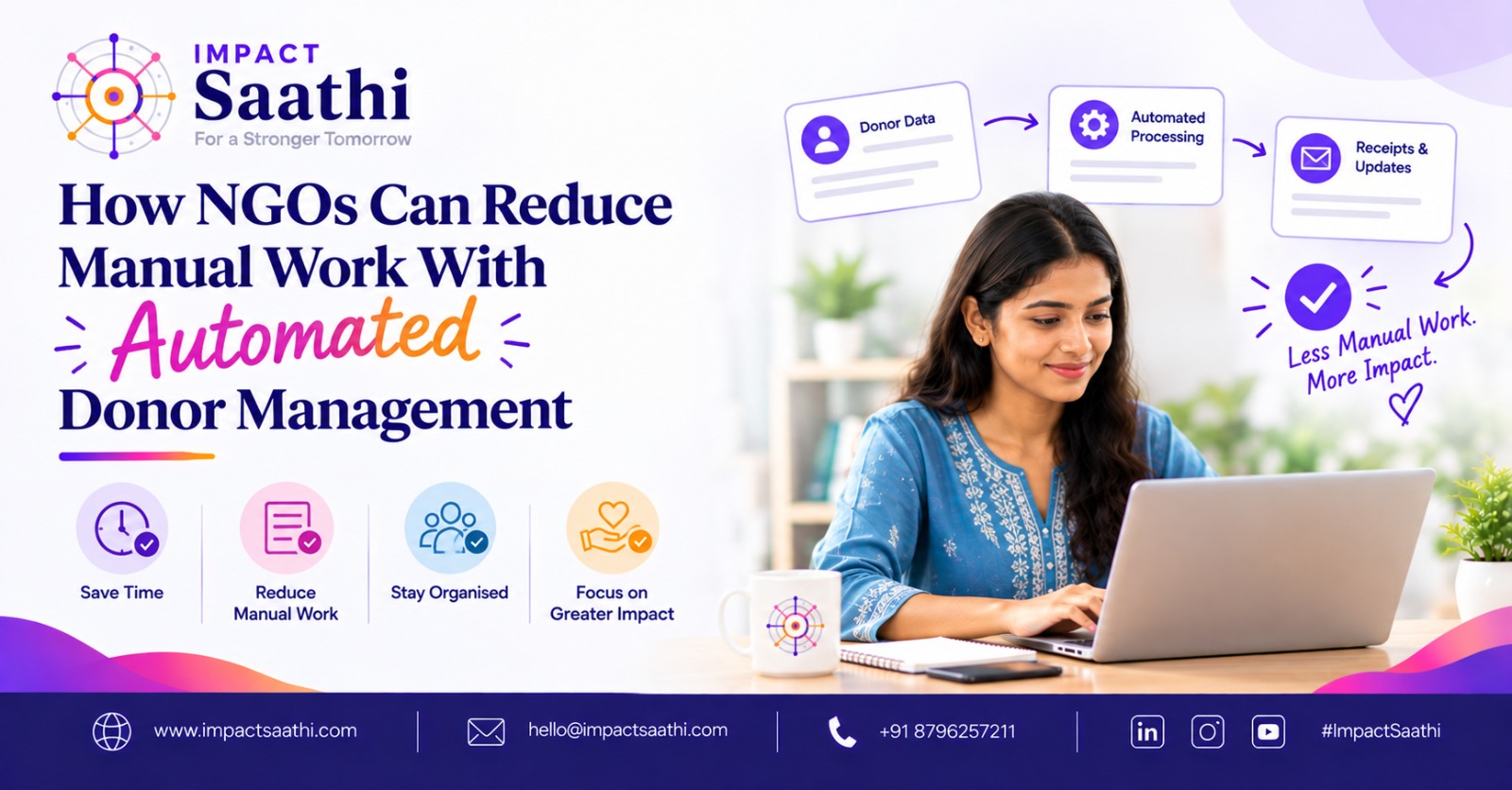
Donation → Excel → Word → Email → Folder → Follow-up
the process can become:
Donation → Automated workflow → Receipt + Notification + Record
The exact capabilities depend on the platform, but the operational principle is straightforward.
What NGOs Should Look for in Donor Management Software
Before selecting a platform, NGOs should evaluate:
Donation tracking
Can the system capture and organise donations accurately?
Receipt automation
Can documentation be generated without repeated manual entry?
Donor CRM
Can the organisation see a donor's historical relationship?
Communication
Can notifications and updates be sent efficiently?
Campaign management
Can donations be associated with specific campaigns?
Reporting
Can management access useful reports?
Security
How is donor information protected?
Compliance support
Does the system support the organisation's applicable compliance workflows?
Scalability
Can it handle increasing donation volume?
Impact Saathi's Approach
Impact Saathi positions itself differently from traditional donor-discovery or fundraising platforms.
Its website explicitly describes the platform as beginning after the donation happens.
Its focus includes:
Donation and payment management
80G receipt generation
Fund-utilisation updates
Notifications
NGO administration
CSR and compliance reporting
This makes it particularly relevant for NGOs that already have fundraising channels but need a better way to manage what happens afterwards.
Who Needs Automated Donor Management?
Automated donor management can be useful for:
Growing NGOs
NGOs receiving online donations
Organisations running frequent campaigns
NGOs with recurring donors
NGOs managing corporate contributions
Organisations with limited administrative staff
NGOs looking to reduce spreadsheet dependency
FAQs
What is automated donor management?
Automated donor management uses software to reduce repetitive administrative work associated with donations, donor records, receipts, communication and reporting.
Why should NGOs automate donor management?
Automation can reduce repetitive work, improve consistency, speed up donor communication and make historical records easier to access.
Can donor management software generate 80G receipts?
Some platforms can automate receipt generation. NGOs should ensure their processes remain aligned with current Income Tax Department requirements.
Can automated donor management improve donor communication?
Yes. Automated workflows can help send confirmations, receipts and campaign or fund-utilisation updates consistently.
Is an NGO CRM the same as donor management software?
The terms can overlap. A donor-management platform generally focuses on donor relationships, while an NGO CRM may include broader organisational and fundraising functionality.
Is automated donor management suitable for small NGOs?
Yes. Smaller NGOs can benefit significantly because automation can reduce administrative work when staff resources are limited.
Does automation replace NGO staff?
No. Automation is intended to reduce repetitive tasks. Human teams remain responsible for donor relationships, financial decisions, programme management and governance.
Conclusion
Donor management becomes increasingly difficult when an NGO grows but its systems remain manual.
The solution isn't necessarily more spreadsheets or more administrative staff.
A better approach is to connect the donation lifecycle.
When donation records, receipts, notifications, fund-utilisation updates and reporting are connected, NGOs can create a smoother experience for both staff and donors.
Automated donor management allows NGO teams to spend less time repeating administrative tasks and more time building meaningful relationships around their mission.
Impact Saathi follows this post-donation approach by connecting donations, automated 80G receipts, donor notifications, fund-utilisation updates and audit-ready records in one platform.